1 Building a radar, not another lead list
GovCon Leads Radar — Fast and cheap, not just promised but guaranteed
· 8 min read
Product GovCon Leads Radar Design
You're reading Part 9 of 10 in the GovCon Leads Radar series.
Use the Series Navigation button at the top-right to browse all posts in the series.
Start from the beginning →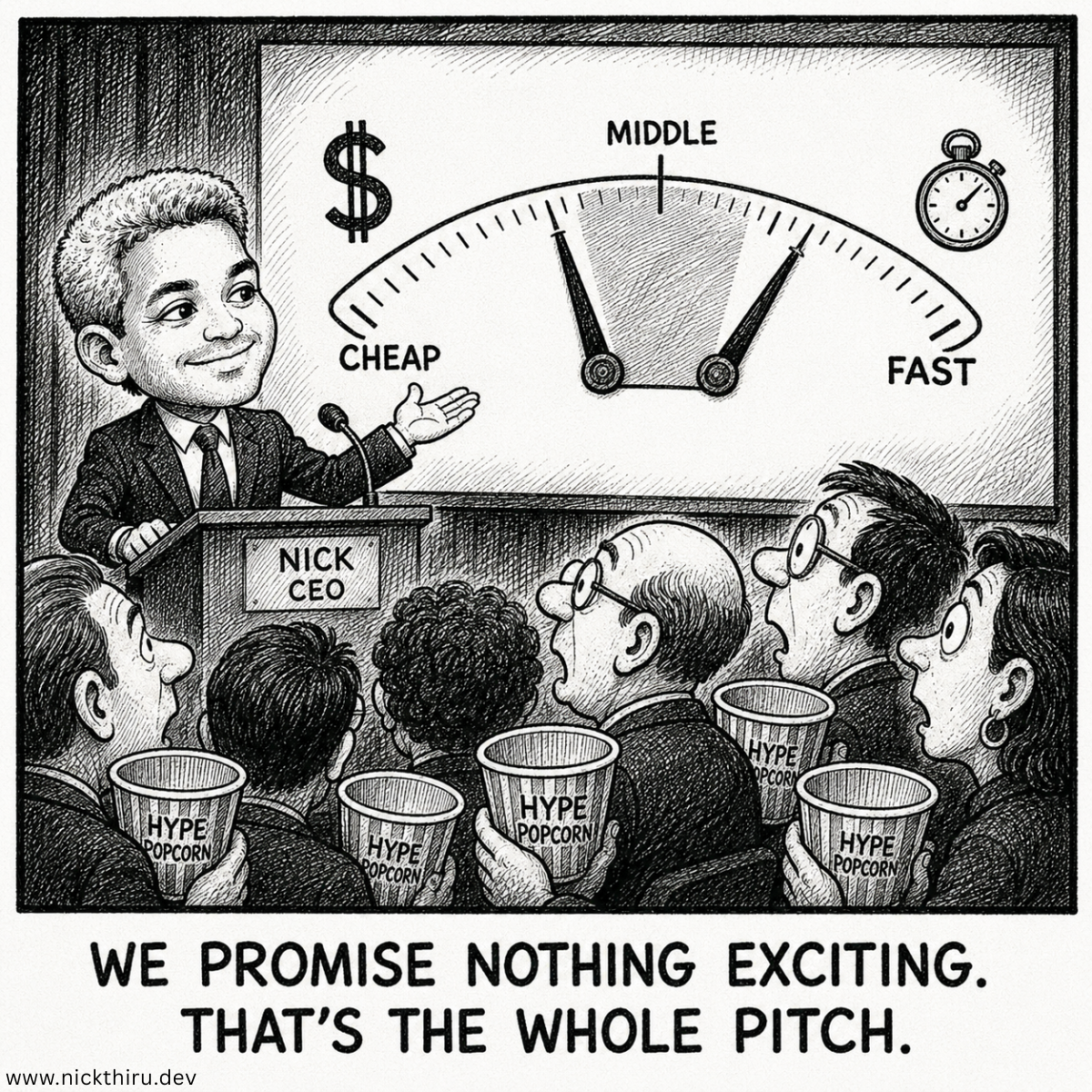
The User Moment
Picture a federal-contracting seller opening their laptop at 7 a.m. They’ve got fifteen minutes before their first call, and a stack of leads that refreshed overnight. Somewhere in that stack is a compliance flag that matters — a mismatch that could sink a bid if it’s missed, or a false alarm that wastes an hour if it’s chased for nothing.
That seller doesn’t care about our infrastructure. They care about one thing: is this ready when I need it, and can I afford to check it every single morning without thinking twice?
That’s the real ask behind “fast and affordable.” Not a nice-to-have. Not a tagline. A daily-use requirement. If checking the tool costs more than the time it saves, or takes longer than making a coffee, sellers will quietly go back to manually scanning listings, and the whole point of building a lead-triage radar evaporates.
So the question I had to answer wasn’t “can I make this fast and cheap?” It was: what do “fast” and “cheap” actually mean, in numbers a user could verify, and what happens when the system is under real load?
The Design Problem
Here’s the uncomfortable truth about most product promises: “fast” and “affordable” are marketing words until someone writes down a number and agrees to be held to it. Before this stage, my speed and cost intentions lived as good intentions: reasonable, well-meant, and completely unenforceable.
The hard part wasn’t picking impressive-sounding numbers; it was picking honest ones. Numbers that reflected how the product actually works — a once-a-day batch refresh, not a live chat interface — rather than numbers borrowed from a category the product doesn’t belong to.
It would have been easy to promise sub-second responses everywhere, kinda the way flashy AI demos do. But GovCon Leads Radar isn’t a live assistant answering questions in real time — it’s a daily dashboard a seller checks each morning. Holding it to real-time-interactive speed standards would have been dishonest, and worse, it would have quietly pushed engineering effort toward optimizing the wrong thing.
There’s also a deeper design problem underneath: cost, speed, and reliability all pull against each other. Make it cheaper, and you risk making it slower or less accurate. Make it faster, and you risk making it more expensive. Every one of those trade-offs needed a rule decided in advance. . .not improvised under pressure the first time a bill comes in high or an incident hits at 2 a.m.
The Options
I considered three broad paths for how to define these commitments.
Option one: pick a single flashy number for each metric — “results in under a second,” “80% cheaper,” clean bullet points for a landing page. Tempting, and easy to market. But single numbers lie by omission. Real-world cost savings from caching depend on real usage patterns that don’t exist yet at this stage, and pretending otherwise means setting a promise up to fail the first month it’s tested against real traffic.
Option two: leave it vague — “we’ll keep costs low and things running smoothly,” the classic hand-wave that every early-stage product is tempted to make. This preserves flexibility, but it also means there’s nothing a user, or an engineer, can actually be held to. Vague promises don’t get enforced; they get forgotten the moment there’s schedule pressure.
Option three — the one I’m going with — was to define a defensible range instead of a point estimate, and to separate “what we’re promising the user” from “what we’re targeting internally to hit that promise.” Cost efficiency from smarter caching, for example, gets described as a real range rather than a single headline percentage, because that’s what the evidence actually supports right now. It’s less exciting on a marketing slide, but it’s more trustworthy in production.
Alongside that, I made a decision that might look small but matters a lot: not every cost or speed target is up for negotiation. Some things, such as compliance-critical checks for instance, don’t get cheaper just because the month’s cost numbers are running high. Cost optimization happens within a boundary, never by cutting corners on the calls that actually protect the user from a bad decision.
The Build
What I ended up with is a small set of concrete, user-facing commitments rather than marketing prose.
On speed: because sellers interact with a daily-refresh dashboard, not a live chat window, the real commitment isn’t “instant answers,” it’s that the day’s results are ready and complete before the seller’s workday starts, every day, without exception spilling over into the next cycle. And for the moments when something does go wrong, I’d have built toward a different kind of speed promise: a real-time incident view designed so that anyone checking on system health can understand what’s currently broken, and how bad it is, in well under a minute; not by digging through logs but by glancing at a single screen.
On cost: instead of promising a specific percentage savings from smarter caching, I committed to a realistic range, landing somewhere between roughly a third and four-fifths less than the uncached cost, acknowledged honestly as unproven until real usage data comes in. That’s a very different kind of promise than “80% cheaper.” It’s the kind that survives contact with reality.
And underneath both of those sits the floor that matters most for trust: whatever cost or speed pressure the system is under, the calls that actually protect a user from a bad compliance decision are never the ones that get cheapened out. Quality and safety come first, cost efficiency comes second within a defined boundary, and raw speed is optimized last. . .only after the first two are already satisfied.
The Struggle
None of this became trustworthy without first surviving an uncomfortable internal audit. When I sat down to turn these promises into enforceable numbers, the working plan itself had gaps and contradictions in it — pieces that didn’t line up cleanly with what had already been decided earlier in the project.
Rather than paper over the inconsistency or quietly pick whichever version was easiest, I went back to the one thing that couldn’t be argued with: the specific, already-agreed acceptance criteria. Wherever the plan and the criteria disagreed, the criteria won, and the plan got rebuilt around them. It’s a small, unglamorous discipline, but it’s also the same discipline the finished product now enforces on its own numbers. If I’m going to hold the system to honest, checkable commitments, I had to hold our own working process to the same standard first.
The Verdict
Does this solve the actual problem? Mostly, yes, with one honest caveat.
The core promise now holds up: sellers get a defined, checkable speed guarantee built around how they actually use the product, a cost model that admits what it doesn’t yet know instead of overselling what it hopes to achieve, and a hard line protecting the checks that matter most, no matter what the budget looks like that month.
The caveat is that a couple of pieces — exactly how fast individual AI-generated write-ups return, and exactly how fast the dashboard itself loads — aren’t nailed down yet. I chose to say so plainly rather than invent comforting numbers to fill the gap. That’s a deliberate trade: less polish today, more credibility tomorrow, because a promise with a visible gap in it is more trustworthy than a promise with a plausible-sounding lie plugged into the hole.
The bigger shift is this: performance and cost stopped being things I’d tune after launch and started being things decided on purpose, in advance, with a real dashboard as the eventual proof. That’s the difference between hoping a product will be reliable and designing it to be.
Your Turn
If a tool you paid for made you a specific, numeric promise about speed or cost instead of a vague reassurance, would that actually change how much you trusted it, or how you’d use it day to day?
Have thoughts on this? I'd love to hear them. The conversation is happening on:
Now Building
GovCon Leads Radar
Turn raw USA federal contracting data into ranked, actionable lead lists. AI-driven tiering of USAspending.gov prospects, automated SAM.gov cross-referencing for compliance flags and POC data. Identify best-fit government sales prospects in minutes, not hours.
Learn more and join the waitlist